Extending UCM Store
Overview
In the Unified Cache Manager (UCM) architecture, the Store component handles:
- Space Management: Allocation and scaling of KV Cache storage
- Persistence: Durable storage and recovery of KV Cache data
- Tiered Transfer: Efficient data movement between storage hierarchies
- Data Processing: Quantization, compression, and encoding transformations
Built-in Store Ecosystem
UCM provides production-ready Store implementations with the following dependency architecture:
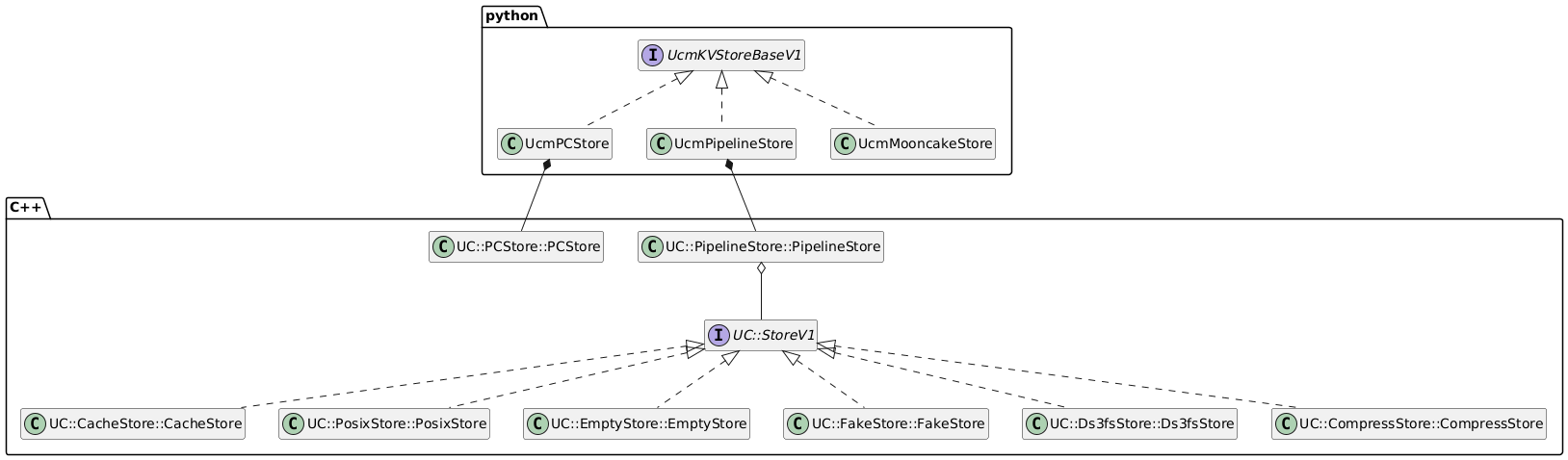
Extension Options
Beyond built-in Stores, UCM supports three extension patterns:
| Method | Implementation | Performance | Use Case | Rating | Reference Implementation |
|---|---|---|---|---|---|
| Pure Python | Python only | 3/5 | Prototyping, algorithm validation | 2/5 | UcmMooncakeStore |
| Python/C++ Hybrid | Python + C++ | 4/5 | Complex logic with performance-critical paths | 3/5 | UcmPCStore |
| Pure C++ | C++ only | 5/5 | Production, high-performance scenarios | 5/5 | UC::CacheStore::CacheStore |
Pure Python Extension
For rapid prototyping and algorithm validation where development speed outweighs runtime performance.
Implementation Steps
-
Inherit the base class
from ucm.store.ucmstore_v1 import Task, UcmKVStoreBaseV1 class UcmCustomPythonStore(UcmKVStoreBaseV1): def __init__(self, config: dict): super().__init__(config) -
Implement required methods
 @abstractmethod
 def lookup(self, block_ids: List[bytes]) -> List[bool]:
     """Check presence of blocks in external storage."""
     pass
 @abstractmethod
 def lookup_on_prefix(self, block_ids: List[bytes]) -> int:
     """Check presence of blocks in external storage."""
     pass
 @abstractmethod
 def prefetch(self, block_ids: List[bytes]) -> None:
     """Asynchronously prefetch blocks into high-speed cache."""
     pass
 @abstractmethod
 def load(self, block_ids: List[bytes], shard_index: List[int], dst_tensor: List[List[torch.Tensor]]) -> Task:
     """Initiate transfer of KV cache from storage to device."""
     pass
 @abstractmethod
 def dump(self, block_ids: List[bytes], shard_index: List[int], src_tensor: List[List[torch.Tensor]]) -> Task:
     """Initiate transfer of KV cache from device to storage."""
     pass
 @abstractmethod
 def load_data(self, block_ids: List[bytes], shard_index: List[int], dst_addr: List[List[int]] | np.ndarray) -> Task:
     """Low-level fetch: copy KV data to device pointers."""
     pass
 @abstractmethod
 def dump_data(self, block_ids: List[bytes], shard_index: List[int], src_addr: List[List[int]] | np.ndarray) -> Task:
     """Low-level dump: copy KV data from device pointers."""
     pass
 @abstractmethod
 def wait(self, task: Task) -> None:
     """Block until the given transfer task completes."""
     pass
 @abstractmethod
 def check(self, task: Task) -> bool:
     """Non-blocking poll for task completion."""
     pass
Note: Full interface specifications are in
ucm/store/ucmstore_v1.py
- Register your Store
# ucm/store/factory_v1.py
UcmConnectorFactoryV1.register_connector(
    "UcmCustomPythonStore",
    "ucm.store.custom.connector",
    "UcmCustomPythonStore"
)
Performance Warning: Python implementations are GIL-bound and unsuitable for high-throughput scenarios. Use only for development and testing.
Hybrid Python/C++ Extension
Best for balancing productivity with performance—implement hot paths in C++, orchestrate with Python.
Architecture
┌─────────────────────────┐
│  Python Wrapper Layer   │  ← Business logic, config, API surface
│    (ucm/store/cpy/*)    │
└────────────┬────────────┘
             │ pybind11
             ▼
┌─────────────────────────┐
│    C++ Core Layer       │  ← Performance-critical operations
│    (ucm/store/cc/*)     │    Memory management, compute kernels
└─────────────────────────┘
Implementation Steps
- Implement C++ core (
hybrid_store.cc)#include "ucm/store/ucmstore_v1.h" namespace UC::HybridStore { class HybridStore : public StoreV1 { public: ~HybridStore() override; Status Setup(const Detail::Dictionary& config) override; std::string Readme() const override; // Core operations Expected<std::vector<uint8_t>> Lookup(const Detail::BlockId* blocks, size_t num) override; Expected<ssize_t> LookupOnPrefix(const Detail::BlockId* blocks, size_t num) override; void Prefetch(const Detail::BlockId* blocks, size_t num) override; Expected<Detail::TaskHandle> Load(Detail::TaskDesc task) override; Expected<Detail::TaskHandle> Dump(Detail::TaskDesc task) override; Expected<bool> Check(Detail::TaskHandle taskId) override; Status Wait(Detail::TaskHandle taskId) override; }; } // namespace UC::HybridStore
Note: Full interface specifications are in
ucm/store/ucmstore_v1.h
-
Create Python bindings (
hybrid_store.cpy.cc)#include <pybind11/pybind11.h> PYBIND11_MODULE(ucmhybridstore, m) { py::class_<UC::HybridStore::HybridStore>(m, "HybridStore") .def(py::init<const Config&>()) .def("Lookup", &UC::HybridStore::HybridStore::Lookup, py::arg("blocks_ids").noconvert()) .def("Load", &UC::HybridStore::HybridStore::Load) ...; // other interface } -
Python wrapper layer
from ucmhybridstore import HybridStore

class UcmHybridStoreWrapper:
    def __init__(self, config: dict):
        self._store = HybridStore(config)

    def lookup_with_retry(self, block_ids):
        """Add Python-level retry logic"""
        result = self._store.Lookup(block_ids)
        if not result:
            result = self._handle_miss(block_ids)
        return result
Pure C++ Extension (Recommended)
Production-ready implementation with maximum performance and resource control.
Why C++?
- Zero-overhead abstraction: Direct memory access, no Python runtime overhead
- Full resource control: Explicit memory management and threading
- Seamless integration: Stackable and chainable with built-in Stores
Implementation Steps
-
Define header (
custom_store.h)#pragma once #include "ucm/store/ucmstore_v1.h" namespace UC::CustomStore { class CustomStore : public StoreV1 { public: ~CustomStore() override; Status Setup(const Detail::Dictionary& config) override; std::string Readme() const override; // Required interfaces Expected<std::vector<uint8_t>> Lookup(const Detail::BlockId* blocks, size_t num) override; Expected<ssize_t> LookupOnPrefix(const Detail::BlockId* blocks, size_t num) override; void Prefetch(const Detail::BlockId* blocks, size_t num) override; Expected<Detail::TaskHandle> Load(Detail::TaskDesc task) override; Expected<Detail::TaskHandle> Dump(Detail::TaskDesc task) override; Expected<bool> Check(Detail::TaskHandle taskId) override; Status Wait(Detail::TaskHandle taskId) override; }; } // namespace UC::CustomStoreNote: Full interface specifications are in
ucm/store/ucmstore_v1.h -
Expose factory function (
custom_store.cc)extern "C" UC::StoreV1* MakeCustomStore() { return new UC::CustomStore::CustomStore(); } -
CMake configuration (
CMakeLists.txt)file(GLOB_RECURSE UCM_CUSTOM_STORE_CC_SOURCE_FILES "./cc/*.cc") add_library(customstore SHARED ${UCM_CUSTOM_STORE_CC_SOURCE_FILES}) target_include_directories(customstore PUBLIC ${CMAKE_CURRENT_SOURCE_DIR}/cc) target_link_libraries(customstore PUBLIC storeintf) file(RELATIVE_PATH INSTALL_REL_PATH ${UCM_ROOT_DIR} ${CMAKE_CURRENT_SOURCE_DIR}) install(TARGETS customstore LIBRARY DESTINATION ${INSTALL_REL_PATH} COMPONENT ucm) -
Dynamic registration (
custom_store.py)from ucm.store.pipeline.connector import UcmPipelineStoreBuilder def _custom_pipeline_builder(config: Dict[str, object], pipeline: ucmpipelinestore.PipelineStore): pipeline.Stack("Custom", str("custom/libcustomstore.so"), config) UcmPipelineStoreBuilder.register("Custom", _custom_pipeline_builder) -
YAML configuration
ucm_connectors:
  - ucm_connector_name: "UcmPipelineStore"
    ucm_connector_config:
      store_pipeline: "Custom"
      # ... custom config
Best Practices
- Memory Management: Use UCM smart pointers and memory pools—avoid raw
new/delete - Exception Safety: Return
UC::Statusobjects instead of throwing exceptions - Thread Safety: Implementations must be thread-safe; UCM calls from multiple threads concurrently
- Performance: Annotate hot paths with
UCM_PROFILER_SCOPE
Quick Decision Guide
Decision Matrix
| Requirement | Pure Python | Hybrid | Pure C++ |
|---|---|---|---|
| Development speed | 5/5 | 4/5 | 3/5 |
| Runtime performance | 3/5 | 4/5 | 5/5 |
| Threading support | No | Partial | Yes |
| Production ready | No | Partial | Yes |
Pre-implementation Checklist
- Reviewed
ucm/store/ucmstore_v1.h - Reviewed
ucm/store/ucmstore_v1.py - Defined supported data types and compression algorithms
- Estimated target QPS and latency SLOs
- Prepared unit tests (reference:
ucm/store/test/) - Selected extension method based on performance requirements
- Created stub implementation and validated registration
Getting Help
- Issues: Report bugs
- Examples: See
ucm/store/test/e2e
Next Steps: Once your Store is implemented, see Prefix Cache Guide for pipeline configuration.